


PURO.EARTH CERTIFIED · PROOF IN 1 MONTH
Flight Carbon Removal
Flight Carbon Removal
Couldn't load pickup availability
This product removes the total global warming impact of one passenger flying for one hour in economy.
115 kg of CO₂ is physically removed from the atmosphere and durably stored for 100+ years, with proof provided within one month of purchase.
Economy Class - Choose the total length of your flight in hours and add to cart.
Business Class - Multiply the amount by 3 to account for the lounge and larger cabin space.
The 115 kg is a comprehensive global figure that represents the full life-cycle and climate impact and includes direct fuel combustion, upstream production, and high-altitude atmospheric effects. See detailed calculations below.
Example flight emission removals:
- 2-hour hop (e.g. New York–Chicago) - 230 kg of CO₂ at €46
- 7-hour round trip (e.g. Helsinki–Naples) - 805 kg of CO₂ at €161
- 13-hour long-haul (e.g. London–Singapore) - 1,495 kg of CO₂ at €299
Read our founder's blog post on removing emissions from flights to Italy.
Calculation data and methods:
-
Direct CO₂ Emissions: 84.4 g/pkm (TTW)
This "Tank-to-Wake" (TTW) number represents the direct CO₂ emissions from the jet fuel burned during the flight. We use 84.4 g per passenger-kilometer (pkm), which is derived from the analysis of 27 million actual commercial flights, reflecting a real-world average across all aircraft types and global regions and accounts for actual passenger occupancy.
Source: University of Oxford - Global Aviation Study 2026
-
Non-CO₂ Multiplier: 1.7 (RFI / GWP100)
The Radiative Forcing Index (RFI) is a multiplier used to calculate the Global Warming Potential (GWP) of non-CO₂ effects of flying, such as nitrogen oxides and water vapor, which create heat-trapping contrails at high altitudes. We use RFI 1.7 based on a 100-year time horizon (GWP100), which is a widely accepted baseline and commonly used in corporate ESG reporting and GHG Protocol compliance.
Source: Harmonised Guide on Flight Emissions 2026
-
Upstream CO₂ Emissions: 20.3% (WTT)
The "Well-to-Tank" (WTT) ratio accounts for the carbon footprint of the jet fuel before it reaches the aircraft, including crude oil extraction, refining, and global transport to airports. We apply a 20.3% uplift to ensure we account for the full life-cycle of the fuel, not just the portion burned in the air. This is derived by calculating the percentage difference between the ICAO Global Baseline for a full life-cycle (89.1 g CO₂e/MJ) and the standard direct combustion value (74.1 g CO₂e/MJ).
Source: ICAO Life Cycle Emissions Document
-
Average Flight Duration: 2h 15min
The current global average duration for a commercial passenger flight segment. We use 2.25-hour average to calibrate our efficiency data. This allows us to offer a standardized "1 Hour" unit that is accurate for the majority of global travelers.
Source: Aviation Week: 2025 Flight Hours Analysis -
Flight Distance per Hour: 700 km
The average distance a commercial aircraft covers in one "Block Hour" (gate-to-gate). We use 700 km to account for the total flight journey. It is calculated using the average distance per commercial passenger flight of 1,578 km, derived from the study (43.3bn kilometers flown divided by 27.45m flights), and then divided by the current global average flight duration of 2.25 hours. This results in an average block speed of approximately 700 km per hour.
Source: University of Oxford - Global Aviation Study 2026
-
Calculation:
1. Direct CO₂: 700 km x 0.0844 kg = 59.08 kg
2. Non-CO₂ (1.7x): 59.08 kg x 0.70 = 41.36 kg
3. Upstream (20.3%): 59.08 kg x 0.203 = 11.99 kg
--> Total: 112.43 kg, rounded up to 115 kg


Your easy steps to remove carbon
🍀 You choose your emissions to remove - from kilograms to lifetime
🍀 You choose the pace - one-time or recurring
🍀 You complete your purchase - check out with preferred payment method
🍀 We confirm your order - immediately after purchase
🍀 We source certified removal credits - from our removal partners
🍀 We retire your removal - within one month of purchase
🍀 You receive proof - a link to your retirement at public registry
What you get when you purchase
With us, you can remove your unavoidable CO₂ emissions immediately and permanently, and complete your climate action with confidence. 🍀
Every carbon removal we sell is certified by Puro.earth, independently verified, and already occurred (ex-post).
Your purchased CO₂ emissions are physically removed from the atmosphere and durably stored for over 100 years by our certified carbon removal partners, such as biochar projects operated by Truecoco and Planboo.
Your purchased amount of CO₂ removal will be retired on your behalf within one month of purchase, and you will get a confirmation email with a link to the retirement record at Puro.earth public registry to show your removal order has been finalised and only counted once.
Why Durable Carbon Removal is Essential
Global temperatures are record high, causing weather extremes and climate instability. This is due to excess atmospheric CO₂ levels that continue to rise. Reducing future emissions cannot solve this alone anymore, so durable carbon removal is required.
Our commitment
Your carbon removal with Remove Carbon Today is:
✅ Already Secured (ex-post) - no future promises, no delivery risk
✅ Independently Certified (Puro.earth) - no vague claims
✅ Truly Additional - no business-as-usual
✅ Durable for Centuries - no temporary storage or reversal risk
✅ Traceable in Public Registry - no double-counting
✅ Proven in one month - no second-guessing
✅ Transparently priced - no hidden markup (see our cost breakdown)
✅ Built for individuals - no paperwork, no waiting
You can verify all our carbon removal retirements with order numbers and public registry links on our carbon removal tracker.
We commit to being worthy of your trust. If you have questions or concerns at any time, please contact us and we'll solve it together.
Common carbon removal choices
-


Flight Carbon Removal
115 kg of CO₂ per hour in economy
Flight Carbon Removal
115 kg of CO₂ per hour in economy
Regular price €23,00Regular priceUnit price per -

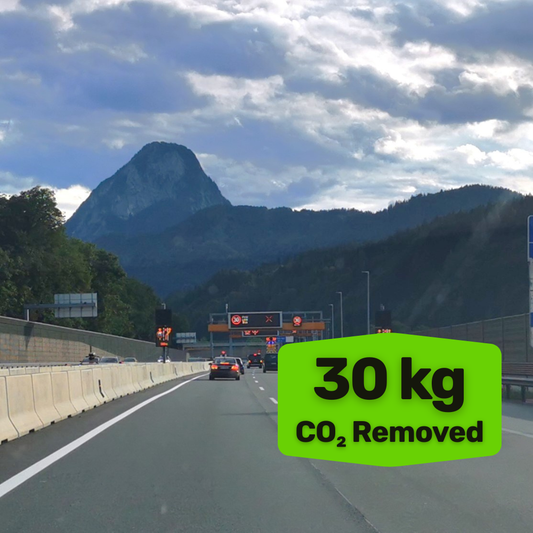
Driving Carbon Removal
30 kg of CO₂ per 100 km on petrol/diesel car
Driving Carbon Removal
30 kg of CO₂ per 100 km on petrol/diesel car
Regular price €5,95Regular priceUnit price per -

1 tonne of Carbon Removal
One-time - Customise in 1 tonne units
1 tonne of Carbon Removal
One-time - Customise in 1 tonne units
Regular price €198,00Regular priceUnit price per -

10 tonnes of Carbon Removal
One-time - Customise in 10 tonne units
10 tonnes of Carbon Removal
One-time - Customise in 10 tonne units
Regular price €1.980,00Regular priceUnit price per


